
Bangladesh Medical & Dental Council (BM&DC)
Criteria for Recognizing Scientific Biomedical Journals
A reference guide for PAHMC Journal editors and authors on the standards biomedical journals must meet for BM&DC recognition.
📅 Takes effect from January 3, 2026
Why recognition matters
Recognition by BM&DC ensures that biomedical journals meet high academic, ethical, and publishing standards, fostering credible research dissemination. By establishing uniform criteria, BM&DC promotes transparency, enhances the quality of medical literature, and supports education, research, and clinical practice — aligning with global standards for advancing medical education through the accreditation of trustworthy journals.
A. Objectives of Journal Recognition by BM&DC
- To set and maintain high academic standards for biomedical journals recognized by BM&DC.
- To uphold ethical practices in scientific research and publishing, ensuring integrity and credibility.
- To standardize and improve the quality of articles published in biomedical journals.
- To provide a platform for the dissemination of trustworthy and impactful research findings.
- To offer credible resources that aid medical education, research, and clinical practice.
- To harmonize journal recognition criteria with international benchmarks for scientific publishing.
B. General Rules for BioMedical Journals
- All journal issues should follow a consistent format, although the cover pages may vary from one issue to another.
- All issues of the journal should be of the same format and colour.
- Every page of the journal should be written as:
- name of journal with year
- volume and issue number (which are available)
- page number of the article
- Each volume of the publication of the journal should start from page 1.
- The journal must mention the editorial board next to the index.
- The index can be given on the front cover page/front inner page.
- Each publication of the journal must include an editorial, which should exclusively be focused on a scientific topic.
- The article should include the dates of receipt, revision, and acceptance.
- It is advisable to add information related to the editorial board, avoiding the name of the panel of the college authorities’ governing body or advisory body in every issue.
- Each journal should have at least five articles, of which:
- A minimum of three should be original research articles.
- Review articles should be written by senior authors who are experts in the relevant field.
- Articles must undergo peer review by senior experts in the relevant field, and one expert preferably from outside the author’s institution. A list of peer reviewers is to be sent to BMDC with each copy of the published journal by the Editor. Submission of reviewers’ reports to BM&DC is encouraged.
- Author details with affiliation should be included at the bottom of the article’s first page.
- The editor of the journal must consider ethical & legal issues before publication of any article. The reference number of the Institutional Review Board (IRB) clearance, with the date, should be mentioned in the article.
- Advertisements in the journal are not allowed.
- Every research article must undergo plagiarism checking, and a plagiarism report must be submitted along with the manuscript by the journal editor.
- Artificial Intelligence (A.I.) based text generation, including any content produced using AI tools, will be strictly monitored, and the use of AI in manuscript writing must be declared. Journals using AI for data analysis or language assistance must ensure that no false or fabricated results are generated.
C. Submission of Journal Copies for BM&DC Recognition
- For recognition, three consecutive issues of the journal must be submitted to BM&DC along with the application.
- The journal’s editors are required to submit six copies of each issue to BM&DC for recognition consideration, along with the fees specified by BM&DC.
- A clear and consistent editorial policy must be stated and upheld.
- A list of peer reviewers is to be sent to BMDC with each copy of the published journal by the Editor.
- Journals published by societies, non-governmental institutes/organizations, and research groups must provide proof of valid registration with the appropriate authority. Journals published by commercial entities such as pharmaceutical companies or manufacturers of medical instruments will not be recognized.
D. Recognition and Certification of Articles Published in Journals
The following criteria are set for the recognition and certification of articles —
- Articles published in journals listed on the Bangladesh Medical & Dental Council (BM&DC) website will be recognized. These journals will be valid for promotion or recruitment without requiring any additional certification from BM&DC.
- Articles published in national or international journals indexed in established databases — such as Medline, PubMed, PubMed Central (PMC), Central Citation Index, Science Citation Index Expanded (SCIE), Embase, Scopus, Web of Science, and the Directory of Open Access Journals (DOAJ) — are automatically recognized, and no separate letter or approval from BM&DC is required.
- The BM&DC Journal Committee must verify any journal published outside the aforementioned indexing authorities. The primary purpose of this verification is to ensure the credibility of the journal. During the verification process, the following important aspects will be examined:
- The journal’s valid International Standard Serial Number (ISSN) and the article’s Digital Object Identifier (DOI) number.
- The Impact Factor (IF), if mentioned in the journal, should correspond to the value projected by Clarivate (formerly Thomson Reuters).
- The journal should not be listed in predatory journal lists such as Beall’s list, Cabell’s Blacklist, or similar.
Only if all these criteria are successfully met, a certificate from BM&DC will be issued for the article published in the journal.
E. Maintenance of Recognition
- To maintain the recognition of BM&DC, a journal should publish a minimum of two issues per year.
- Consistent publication frequency must be maintained; for example, if a journal is published three times a year, this schedule must be followed.
- Editors must submit two copies of each issue to BM&DC immediately upon publication.
- Editors are requested to submit two copies of each issue to the National Health Library for indexing purposes.
- To maintain the BM&DC recognition, every three years, each journal will undergo a review to assess its quality and publication frequency. Failure to publish for three consecutive years or failure to maintain quality may result in the cancellation of BM&DC recognition. Additional fees will be required to complete this review process.
- BM&DC recommends that the journal authority include the phrase “BM&DC Recognized” on the front cover of the journal. This will help other relevant authorities easily identify the journal’s accreditation status.
- The Chief Editor of any recognized journal that has not submitted updated copies to BM&DC for a long time must be notified to submit the updated copies of the journal within the next six (06) months. If the updated copies are not submitted within this period, a letter should be issued stating that failure to comply will result in the cancellation of the journal’s recognition.
F. Charges for Recognition and Maintenance of Recognition
For initial recognition, the journal authority must complete the scrutiny process by paying the prescribed fee per issue at the time of online submission. For renewal of recognition every five years, the journal authority is required to submit a copy of the journal along with the applicable renewal fee. All fees are subject to revision as determined by the BM&DC authority.
Appendix-1 — Uniform Criteria for Manuscript Submission
Guidance for authors submitting a manuscript for publication to the editorial board of a journal.
- Manuscripts written in English on biomedical topics will be considered for publication, provided they have not been previously published or are not under consideration for publication elsewhere.
- If the manuscript includes any tables, data, or illustrations previously published in other journals, the author must obtain written permission from the appropriate authority. This permission letter should be submitted to the editorial board along with the manuscript.
- The authors should sign a cover letter mentioning that all authors have seen and approved the final manuscript for submission.
- The relevancy and contribution of the authors should be clearly stated in the article. Irrelevant persons or those without any contribution should not be entitled as authors/co-authors.
- The materials submitted for publication may be in the form of original research, review articles, systematic reviews, meta-analyses, special articles, case reports, recent advances, new techniques, book reviews on clinical/medical education, or a letter to the editor.
- An author can write a review article only if he/she has written a minimum of two (2) original research articles in his relevant subject or discipline.
- The manuscript may be submitted by the author online or in softcopy following the appropriate criteria as mentioned.
8. Manuscript structure — each component begins on a new page, in sequence:
a) Title page — title of the manuscript, name of the authors with affiliations, name of the departments in which they worked, email address & phone number.
b–c) Title & Abstract — the title should be concise, informative & self-explanatory. The abstract should preferably be structured, with Background, Objectives, Materials & Methods, Results, and a Conclusion.
d) Keywords — 5–7 relevant keywords.
e) Body of the article — presented in the following form:
i. Introduction
Clearly state the research problem, objectives, and significance. Provide background information, review relevant literature, and justify the study’s contribution to the field. Only strictly pertinent references should be cited. Data or conclusions from the work being reported should not be presented in the introduction.
ii. Materials & Methods
Provide a clear, detailed description of the study design, study period, study place(s)/settings, materials, and protocols used, ensuring reproducibility. Include specifics like sample size, sampling method, data collection instrument(s), tools, and method(s), experimental procedures, operational definitions, measurements, data processing, statistical analyses, and ethical issues. Use subheadings for organization and past tense for completed work. Avoid unnecessary details while ensuring critical steps are well-documented. Cite standard methods or protocols and describe modifications. Maintain clarity, conciseness, and logical sequencing for ease of understanding.
iii. Results
Present findings clearly and concisely, using text, tables, and figures. Describe key results without interpretation or explanation, focusing on trends and data that address research objectives. Include statistical analyses, emphasizing significant outcomes. Organize logically, matching methods, and use subheadings for clarity. Avoid redundancy with tables or figures.
iv. Discussion
Interpret findings, linking them to the research objectives and existing literature. Avoid repetition of results and focus on outstanding findings. Highlight the significance, implications, consistency, strengths, and limitations of the results, avoiding data repetition. Compare findings with previous studies, explain unexpected outcomes, and propose future research directions. Maintain a logical flow and ensure conclusions are evidence-based.
v. Tables and Figures
Ensure that table and figure numbers and their titles/legends are written clearly and concisely. Each table and figure should be sequentially numbered and accompanied by a descriptive title and legend that accurately summarizes its content, enabling readers to understand its purpose without referring to the main text. The source of illustrations, tables, and figures must be cited, along with confirmation of permission obtained.
vi. Abbreviations and Symbols
Define abbreviations upon first use, use standard symbols, and follow the journal’s formatting guidelines. Avoid abbreviations in the title of the article.
f) References — follow the journal’s citation style (e.g., APA, MLA, Vancouver, Harvard), ensuring consistency in author names, publication year, title, journal name, volume, issue, and page numbers.
g) Acknowledgment
h) Conflict of interest
i) Author’s contribution
j) Funding source & Data availability
Source: Bangladesh Medical & Dental Council (BM&DC) — Criteria for Recognizing Scientific Biomedical Journals.
Registrar
Bangladesh Medical & Dental Council
Any issue regarding recognition of Scientific Biomedical Journals by BM&DC, please contact — 01711428936
Recent Posts
-

-

-
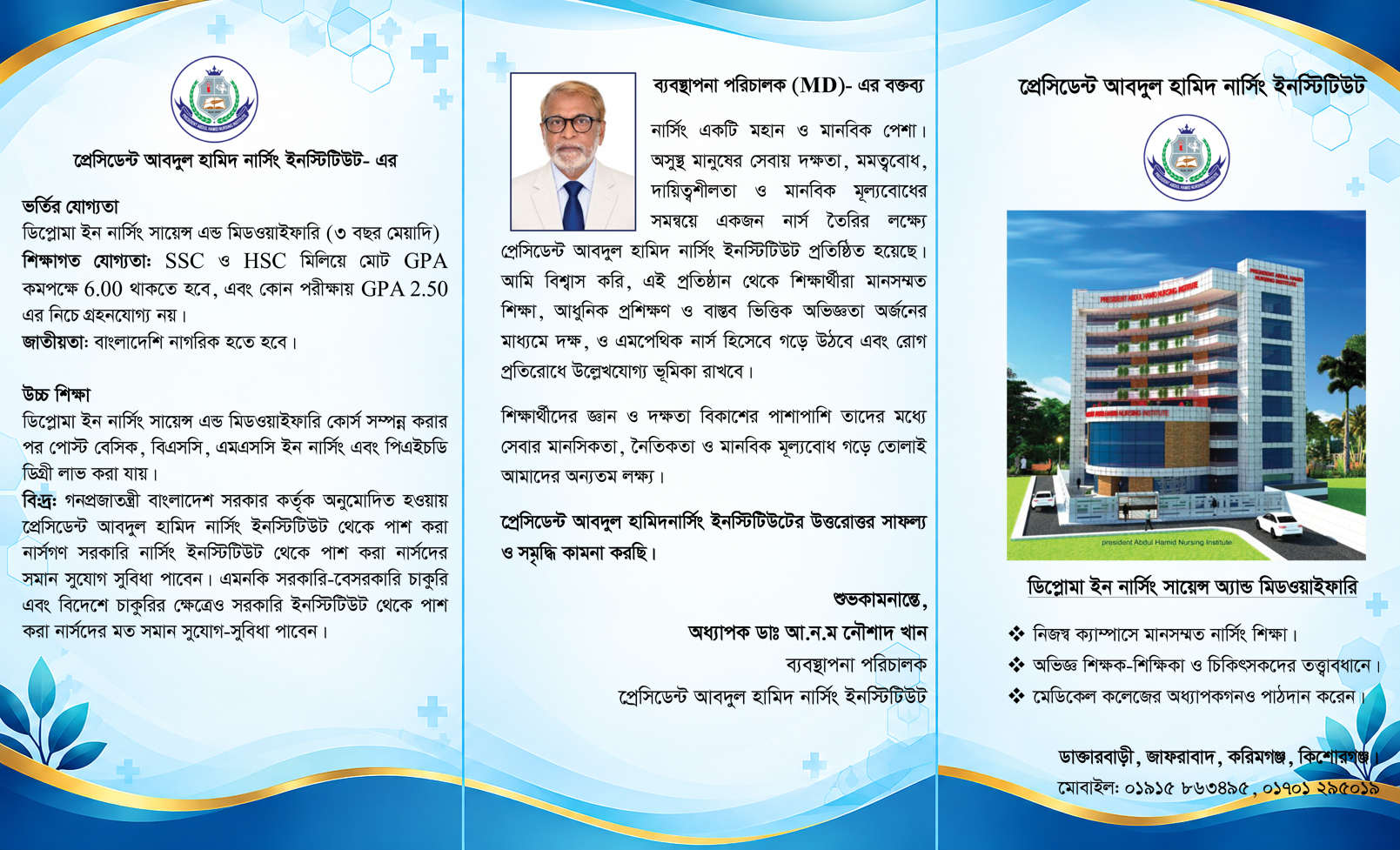
president abdul hamid Nursing institute
26 Sep, 2026 -

-